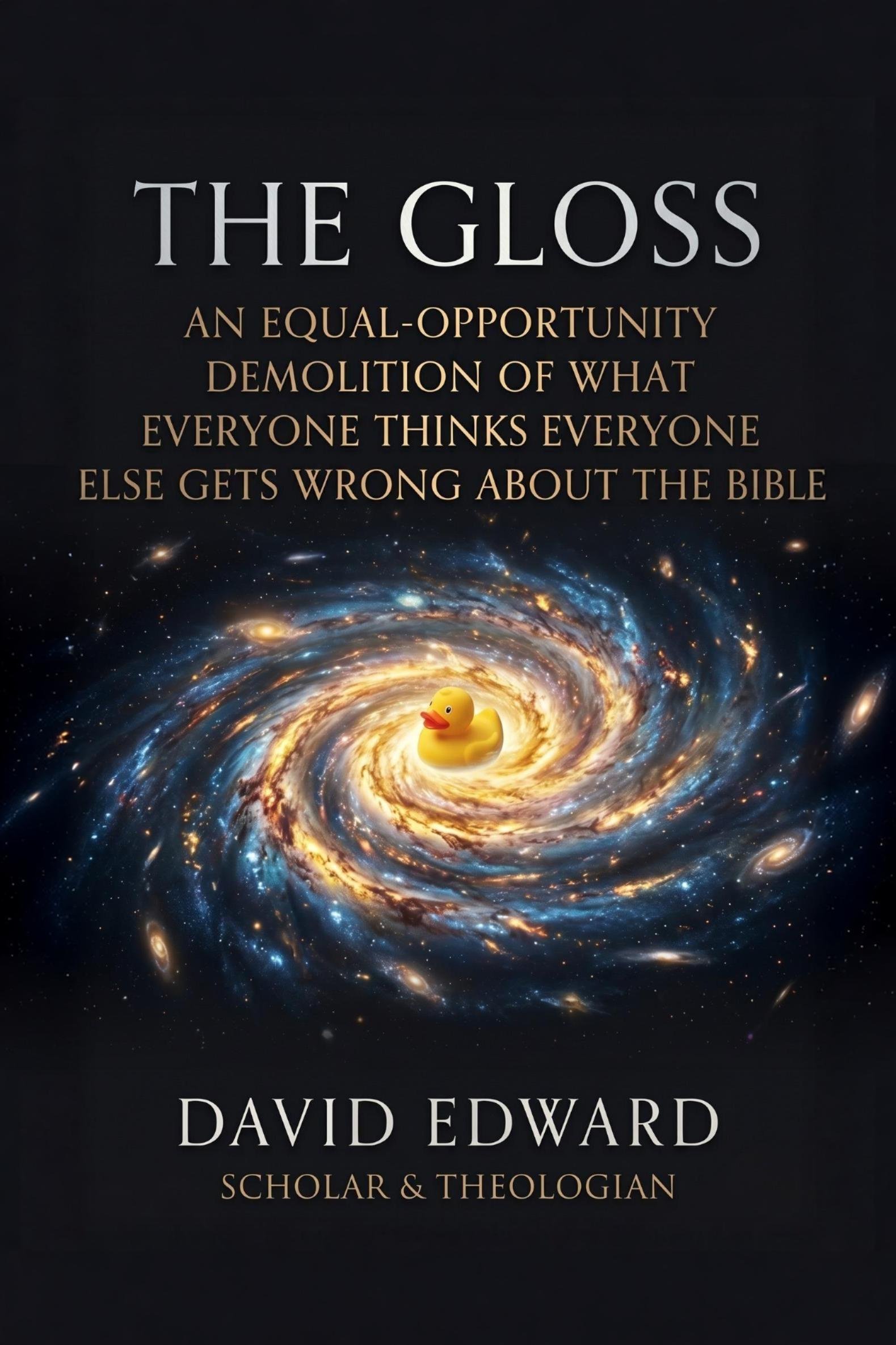
Supposed Biblical contradictions examined without flinching, resolved into something richer than you expected. Everyone gets challenged. That's the point.
The theologian will be mad by page two. The skeptic by chapter seven. The cosmologist by the napkin math. But the text has been sitting there unbothered, waiting for someone to stop arguing about the wrapper and open the thing.
Buy on Amazon
Dragons, Thrones, and the Architecture of Reality. They told you science killed God. They were wrong — about that, and about science. A philosophical thought experiment that corrects both sides.
Amazon ↗
The simple questions everyone needs answered. For those who have driven past churches their whole life, or want to understand what a friend actually believes — without the jargon.
Amazon ↗
A Biblical philosophy of business for Christians who want permission to pursue excellence. If you have wondered whether Monday through Friday matters to God, this book is for you.
Amazon ↗
Biblical principles for business influence. Sunday says humility. Monday says close the deal. For every Christian who has lived uncomfortably between those two sentences.
Amazon ↗
4th Edition. A systems theory methodology for team dynamics and performance. Measure team value, identify structural changes, and map the trade-offs between speed, quality, and cost.
Amazon ↗Scripts posted as episodes air — click any title to read in full.
Welcome to Entry Level Christianity, sponsored by Spirit of Giving USA. I'm David Edward, and this is the show where we take the hard questions seriously. The ones people are actually asking. The questions people worry might mean the Bible can't be trusted, and the doubts that keep them up at night wondering if the foundation is really solid.
Today we're going in on one of those questions. One that sounds, on the surface, like a genuine contradiction in the Bible. Not a soft one either. We're talking about a passage where God appears to send a lying spirit, and we're going to work through it in the original Hebrew, and by the end I think you'll find it's not a contradiction at all. It's actually one of the most honest and searching passages in the whole Old Testament.
Entry Level Christianity is sponsored by Spirit of Giving USA. They collect old devices. Phones, tablets, laptops, refurbish them, and donate them to the Saint Christopher Truckers Relief Fund. Over-the-road truckers are gone for weeks at a time. A lot of them can't afford a smartphone or tablet. Getting a refurbished device into a trucker's household means a dad can read his daughter a bible story from a rest stop in Oklahoma. You can go directly to their website at spiritofgivinguse.com or find a link on entrylevelchristianity.com, where you'll also find my book, The Gloss: What everyone thinks everyone else gets wrong about the Bible; and also links to the YouTube channel and everything else about the show.
People think the Bible has contradictions. In a real way, to real people, they think there are problems. For a lot of folks it isn't a slow drift into doubt. It was a moment. One verse, one argument, one thing somebody said that they couldn't answer, and something cracked.
Maybe it was a college professor. Maybe it was a friend who'd done some reading. Maybe it was a late night online. And somebody pointed at two verses and said, see? The Bible contradicts itself. How can you trust any of it?
And the painful thing is, sometimes those people don't get a real answer. They get defensiveness. They get you just have to have faith. They get someone who changes the subject. And that non-answer does more damage than the question did, because now it looks like the faith can't hold up to scrutiny.
This show exists because I don't believe that. I believe the Bible can take the hard questions. I believe that when you actually dig in, get into the original languages, understand the history, who's speaking to whom and why, the contradictions have a way of dissolving. Not because you're forcing them to. But because the surface reading was always thinner than the text itself.
So today I want to model that.
Here are the two verses.
Proverbs twelve, twenty-two: "Lying lips are an abomination to the Lord." Plain statement. God hates lying. Full stop.
Then First Kings twenty-two, twenty-three: "The Lord has put a lying spirit in the mouth of all these your prophets."
Same God. Same book. One hand saying God hates lies, the other saying God sent one. If you've never encountered this before, note it, because it's a fair tension. And if somebody has used this exact pairing to argue against the faith, we're going to walk through this properly. Into the story, into the Hebrew, into what it actually means about who God is.
But first we need to meet the players. Because First Kings twenty-two doesn't exist in a vacuum. The year is roughly 850 BC. The kingdom of Israel has been split for about eighty years. You have the northern kingdom, Israel, ruled by a man named Ahab. And you have the southern kingdom, Judah, ruled by a man named Jehoshaphat. These two kings have formed an alliance. Ahab wants to go to war to retake a city called Ramoth-gilead and is asking Jehoshaphat to ride with him.
Jehoshaphat is cautious. He's a good king, a man who actually fears God, and he says, let's hear from a prophet first. Let's ask the Lord.
So Ahab brings out four hundred prophets. Four hundred men, all saying the same thing. Go up, go to war, the Lord will give it into your hand, you'll prosper. All in agreement, all telling the king what the king wants to hear.
And Jehoshaphat looks at this and something doesn't sit right. He asks, is there not another prophet of the Lord we could consult?
And Ahab says, and this is the telling line, yes, there's one. His name is Micaiah. But I hate him, because he never prophesies good for me. Only bad news.
That line tells you everything. He's got a truth-teller available. He knows who the real prophet is. And his problem with him isn't that Micaiah is wrong. His problem is that Micaiah tells him things he doesn't want to hear. This is a man who's already made his choice. He just wants the paperwork to match.
So they send for Micaiah. On the way, the messenger pulls him aside and says, all four hundred are saying the same thing. Good news for the king. Just go along with it.
And Micaiah says: as the Lord lives, what the Lord says to me, that I will speak.
That's it. His job is to say what's true. They bring him before the kings, and at first he appears to play along. He says, go up and prosper. But the way he says it makes Ahab suspicious, and he presses him. And then Micaiah drops the mask. He says: I saw all of Israel scattered on the mountains like sheep without a shepherd.
Go to this battle, and you won't come home.
The true prophet, to the king's face, says you're going to die. And Ahab's response? Didn't I tell you he never says anything good about me. He throws Micaiah in prison on bread and water. Until he comes back from the battle.
Until he comes back from the battle.
He already knows what Micaiah said. He throws him in prison, marches out anyway, and expects to come back. That's the level of self-deception we're dealing with. A man who's heard the truth, discarded it, and built a future around something a prophet of God just told him won't happen.
That's the setup. Now let's go into the Hebrew.
A man in a prison cell, telling the truth to someone who didn't want it. A king walking out to a battle he's already been told he won't survive. Two men, same moment, completely opposite relationships with the truth. That contrast matters when we get to what the Hebrew actually says.
*
We're going to take a short break, we’ll be right back…
Welcome back to Entry Level Christianity, sponsored by Spirit of Giving USA. I'm David Edward.
We've been working through the lying spirit passage in First Kings twenty-two. We've looked at the Hebrew, we've met Ahab, and we've seen how the apparent contradiction dissolves when you actually go into the text. Now I want to go somewhere deeper, because this passage isn't just a Bible difficulty with a solution. It's a mirror. And it's uncomfortable in a way that matters.
Before Micaiah gives his final word to Ahab, he tells him something else. He gives him a picture, a vision of what happened in the heavenly court. And this is the verse that, pulled out of context, looks like a problem.
He says, and this is First Kings twenty-two, nineteen through twenty-two: I saw the Lord sitting on his throne, and all the host of heaven standing beside him. And the Lord said, who will entice Ahab, that he may go up and fall at Ramoth-gilead? And one said this, and another said that. Then a spirit came forward and stood before the Lord and said, I will entice him. And the Lord said, how? And he said, I will go out and be a lying spirit in the mouth of all his prophets. And the Lord said, you are to entice him, and you shall succeed. Go out and do so.
And then Micaiah says the line: "The Lord has put a lying spirit in the mouth of all these your prophets."
On the English surface, that looks like God authorized a lie. And if that's what it means, we've got a real problem, because Proverbs is clear that God hates lying lips. But the English translation is doing something the Hebrew doesn't do. It's collapsing two words that carry more weight than the translation lets on.
The phrase is ruach sheqer. Two words. And both of them are wider than what we get in English.
First word. Ruach. In English it becomes spirit, and we read that and we picture something dark and demonic slipping in through a back door. But ruach in Hebrew is the word for spirit, breath, and wind. All three, depending on context. It's the same word used in Genesis chapter one, verse two, when the Spirit of God hovers over the waters, and in Genesis two, verse seven, for the breath of life God breathes into Adam. Two verses after our passage it's ruach Adonai, the Spirit of the Lord. Both readings are inside that one word.
Second word. Sheqer. Usually rendered falsehood or lying. But sheqer doesn't require that anyone spoke a false thing. At its root it's about something that doesn't turn out to be what someone expected. It disappoints. So a ruach of sheqer can mean a breath whose word doesn't go the way Ahab thought it would, without anyone speaking a lie. The Hebrew holds that reading.
Then there's the verb. God asks who will patah Ahab. Patah is translated as persuade, entice, or win over. The core of it is talking someone into something. Not force. Nobody drags Ahab anywhere. He walks out to that battle on his own two feet, by his own choice.
Now here's the whole thing back with that fuller translation. "The Lord sent a breath from His presence... that persuaded Ahab to go up to the battle... a word that wouldn't turn out the way Ahab assumed."
A breath from the Lord. Persuading a man, not forcing him, toward a word that wouldn't go the way he expected. This is exactly the kind of thing I get into in The Gloss, my book on what everyone thinks everyone else gets wrong about the Bible. Links at entrylevelchristianity.com. But first, let's finish the story.
The prophets said: go up and prosper. And I want to look closely at that word. Prosper. Because here's what everyone assumes it means. They hear prosper and they picture Ahab winning the battle, coming home in triumph, keeping his throne, adding to his kingdom. That's the picture Ahab had in his head. That's what he went to battle expecting.
But what does prosper actually mean for a man like Ahab?
Let's talk about who Ahab actually is. Because this isn't a man being ambushed by God without context. This is one of the most morally catastrophic kings in the whole narrative of the Old Testament. The text says explicitly that Ahab did more to provoke the Lord to anger than all the kings of Israel before him. And that's a long list.
He married Jezebel and together they introduced Baal worship into Israel on a national scale. He built a temple to Baal, set up an Asherah pole, and allowed the systematic murder of God's prophets. Elijah at one point believed he was the only prophet left alive.
And then there's Naboth.
Naboth was a man who owned a vineyard next to Ahab's palace. Ahab wanted it, offered to buy it or trade for it. Naboth said no, this is my family's inheritance, I can't give it up. A legal answer under Israelite law.
Jezebel arranged to have Naboth falsely accused of blasphemy. Two false witnesses. He was dragged out and stoned to death. And the moment he was dead, Ahab went down to take possession of the vineyard.
This is the man God's dealing with. Blood on his hands, sitting on a stolen vineyard, his sentence already pronounced. Elijah told him directly, First Kings twenty-one, verse nineteen: in the place where dogs licked Naboth's blood, dogs will lick your blood. The judgment was already spoken. The only question was when.
So now go back to the word prosper.
For a man drowning in guilt, accumulating the weight of murder and idolatry and the blood of innocent people, what is the most prospering thing that could possibly happen to him? To be stopped.
Every day Ahab sits on that throne is another day of evil, another day of consequences building. Going up to that battle and falling, that's the end of the accumulation. It's the best thing for Ahab. The word came true. He did prosper. Just not the way he imagined.
And it's mercy for everyone else.
The nation he was crushing, released. Jehoshaphat, the good king who rode alongside him, walks off that battlefield alive. The long darkness of Ahab's reign comes to an end. The same word that brought Ahab down was deliverance for every person living under him. One man's judgment. A whole people's rescue.
So where's the lie?
There isn't one. Nobody lied. God spoke true. The prophets' words came true. Prosper was true, for the nation, for Jehoshaphat, and for Ahab himself in the deepest sense. The only thing that didn't line up was what Ahab assumed it meant. He heard prosper and decided it meant he'd win the battle and keep his crown. God never said that. Ahab filled in the blank with what he wanted.
And that's not God lying to a man. That's a man presuming on God.
And here's what makes this passage so searingly honest. Ahab had the truth available to him. Micaiah stood right in front of him and said plainly: you're going to die. He heard it. He put the man in prison and went anyway. He didn't want the true word. He wanted the comfortable one. So what God did was not deceive him. What God did was give the man exactly what he wanted, voices telling him to go, and step back and let Ahab's own appetite for the comfortable word carry him where his choices had already earned.
That's not a contradiction with Proverbs. That's Proverbs in action. One verse states the principle. The other shows it landing on a man who violated it. They don't fight. They agree.
*
We'll take a short break. Old devices in your drawer, go to spiritofgivingusa.com. They send you a prepaid label, you ship the devices, they wipe and refurbish them and send them to over-the-road drivers and their families through the Saint Christopher Truckers Relief Fund. Costs you nothing but a trip to the post office. All the links are at entrylevelchristianity.com. Back in a moment.
*
Welcome back. I'm David Edward, this is Entry Level Christianity, sponsored by Spirit of Giving USA. Before the break we established that the lying spirit passage isn't a contradiction. It's a portrait of a man being given exactly what he asked for. Now I want to ask what that means for us.
*
I want to talk about a pattern. Because what we've seen in Ahab's story isn't just ancient history. It's one of the most recognizable patterns in human nature, and I think most of us, if we're honest, have lived some version of it.
Ahab had access to the truth. He knew who the real prophet was. He'd heard Micaiah before. He knew the score. And every time the true word came, he didn't argue with it on the merits. He rejected it because he didn't like what it meant for him. He preferred the four hundred voices. Not because they were more credible, not because their track record was better, but because they told him what he wanted to hear.
And here's the thing about that pattern. It doesn't require a palace and a kingdom to operate. It runs in ordinary life every single day.
It runs when someone stays in a relationship they know is wrong because everyone around them keeps saying it'll work out. Not because the evidence says it will. Because they want to hear it. It runs when someone keeps a habit they know is destroying them because they've surrounded themselves with people who don't challenge it. Four hundred voices. All saying go up and prosper.
It runs in faith itself, and this is the uncomfortable one, when we pick and choose which parts of the Bible we read and which ones we quietly skip past. That's not reading the Bible. That's looking for Ahab's four hundred prophets in the text.
The four hundred prophets weren't lying because they were evil men. They told him what he wanted to hear because that's what he rewarded. Ahab threw Micaiah in prison. The four hundred got to stand in the throne room. The incentive structure was clear. And we do the same thing, constructing lives that reward the people who tell us what we want to hear and push out the ones who tell us what we need to hear. Then we wonder why we keep walking into battles we were warned about.
There's another figure in this story I don't want to pass over. Micaiah.
Think about what it cost him to say what he said. He knew what had happened to the other prophets. He knew Jezebel had been hunting them down. He knew Ahab's track record with truth-tellers. The messenger who came to get him literally pulled him aside and said, look, everyone else is already on board. Just say what they're saying. You'll be fine.
And Micaiah said: as the Lord lives, what the Lord says to me, that I will speak.
He said it. He told the truth. And he went to prison for it.
I think about the Micaiahs in our lives. The people who told us hard things we didn't want to hear, and who we punished for it. Not with prison, but with distance. With coldness. With quietly removing them from the circle. And I think about whether, looking back, they were usually right. The people who love us enough to say the hard true thing aren't obstacles. They're gifts. And the story of Ahab is, in part, a warning about what happens when we treat them as obstacles anyway.
There's one more layer I want to get to before we close, because the passage isn't just about Ahab and his choices. It's about the nature of judgment and mercy, and how those two things can be the same action at the same time.
When God allows the breath of persuasion to confirm Ahab in the direction he's already chosen, that's judgment. Ahab's been warned, repeatedly, over years. He's had Elijah stand in front of him. He's had Micaiah stand in front of him. The sentence has already been pronounced. At some point, the mercy of warning gives way to the judgment of consequence. God steps back and lets a man's own choices take him where they were always going to lead.
But it's also mercy. For the nation. For Jehoshaphat. For every person who will live differently under a different king. The same action that ends Ahab begins something better for everyone around him. This is a pattern in scripture I think we underestimate. Judgment and mercy aren't opposites operating in sequence, mercy first until it runs out, then judgment. They're often the same event, experienced from different angles. What looks like the end of one story is the beginning of another. What looks like loss from inside one life is liberation for everyone around it.
And this is why, when someone asks me whether God is just or merciful, I usually say, yes. Not as a dodge. But because in the most serious passages of the Bible, you genuinely can't pull them apart. Ahab's end is just. And it's merciful. Both, completely, at the same time.
So let me bring this home. We started today with what looked like a flat contradiction. Two verses, same book, same God, apparently saying opposite things. And what we found when we actually went into it, into the Hebrew, into the history, into the story itself, is that the contradiction was never there. It was a surface reading of a deep text.
The English word lying is doing more work than the Hebrew sheqer asks it to. The word spirit is narrower than ruach. And the word prosper turned out to mean something truer and more serious than anyone in that throne room understood.
This is why I keep coming back to the original languages. Not to be academic. Not to make the Bible harder than it needs to be. But because the translations, as good as they are, always one step away from the thing itself. And sometimes that step matters. Sometimes the whole apparent problem dissolves the moment you look at what the word actually carries.
If you want to go deeper on this, and I hope you do, everything is at entrylevelchristianity.com. That's where you'll find The Gloss, my book on what everyone thinks everyone else gets wrong about the Bible, the YouTube channel, and more episodes. The show exists for exactly this kind of question. So if you have one, bring it. No question is too hard, and none is too basic. Entry level means everyone gets a seat at the table.
And if you're someone who stepped back from their faith because somebody pointed at a Bible difficulty, and you didn't get a real answer, and something cracked, I want you to know the crack doesn't have to stay there. Not because we paper over it. But because when you actually look at the thing that cracked it, it usually holds up. Usually better than you expected. The Bible has been asked hard questions for a long time. It tends to be standing when the questions are done.
Before I let you go, one more word about Spirit of Giving USA. Everything I said at the top of the show still stands. If you have old devices, phones, tablets, anything sitting in a drawer, go to entrylevelchristianity.com. The link to Spirit of Giving is right there. Or go directly to spiritofgivingusa.com and reach out to them. They will send you a fully paid shipping label. You pack up the devices, ship them off, and they handle everything from there. Certified data wipe, full chain of custody, refurbished and donated to the Saint Christopher Truckers Relief Fund.
A trucker somewhere is going to video call his kids tonight because somebody sent in an old phone. That's real. That's worth five minutes of your time and a trip to the post office.
Thank you for listening to Entry Level Christianity, sponsored by Spirit of Giving USA. I'm David Edward. All the links, the show, the books, the YouTube channel, and Spirit of Giving USA, are at entrylevelchristianity.com. We'll see you next time.
Welcome to Entry Level Christianity, sponsored by Spirit of Giving USA. I'm David Edward, and this is the show where we take the hard questions seriously. The ones that don't have easy answers. The ones that quietly did damage before anyone thought to check what they were standing on.
Today's episode is a special one. What I'm going to walk you through comes directly from Chapter Five of my book, The Gloss. And I want to say upfront that this particular chapter took a long time to write, because what it's about isn't a translation problem or a language question. It's a methodology question. And the cost of getting methodology wrong, in a domain as consequential as this one, isn't a footnote. It's people. People who were handed a conclusion, accepted it in good faith, and built their distance from the Bible on it. I think by the end of this you'll understand why I felt this chapter had to be in the book, and why I think it's some of the most important material in it.
Entry Level Christianity is sponsored by Spirit of Giving USA. They collect old devices, phones, tablets, laptops, run every one through a certified data wipe with full chain of custody, refurbish them, and donate them to the Saint Christopher Truckers Relief Fund. Over-the-road truckers are gone for weeks at a time, and the hardest part of that isn't the miles. It's the distance. Getting a refurbished device into a trucker's home means his kids can see his face from a rest stop in Wyoming, and his wife can read him a verse before he goes to sleep. If you've got old devices, go to entrylevelchristianity.com. The link to Spirit of Giving is right there, and while you're there you'll find my book, The Gloss: What everyone thinks everyone else gets wrong about the Bible, along with the YouTube channel and everything else about the show.
A lot of people who've stepped back from faith, or who've never been able to take Genesis seriously, are carrying a specific piece of information they picked up somewhere. A professor. A book. A podcast. A conversation with someone who'd done some reading. And the information goes something like this: Genesis wasn't written by one person. It was assembled from multiple older documents, by editors working centuries apart, which is why it reads inconsistently, why the names for God shift, why some stories seem to repeat. The people who study this for a living worked it out. It's been settled for over a hundred years.
That's the claim. And it has done an enormous amount of work. It's given serious, thoughtful people a reason to set Genesis aside. It's unsettled believers who couldn't answer it. It travels easily because it sounds like scholarship. It has dates and names and institutional weight behind it. You don't have to read the original paper to feel the force of it. You just have to hear it from someone who sounds like they know what they're talking about, and something shifts. The ground under Genesis gets softer. And once that happens it tends to stay soft, because nobody comes back with a real answer. They say you just have to have faith. They change the subject. And that non-answer confirms what the claim suggested: that the Bible can't hold up to serious scrutiny.
That's the pattern this show exists to interrupt. Not because the question isn't worth taking seriously. But because the question deserves a real answer, and the real answer in this case is not a matter of faith. It's a matter of methodology. And the methodology has a problem that can be stated clearly, demonstrated directly, and understood by anyone who cares to follow it.
I also want to name something before we go any further. The claim that Genesis was compiled from multiple sources isn't just an academic footnote. It's one of the primary intellectual reasons people have set the Bible down and not picked it back up. It's behind a significant portion of the doubt that circulates in universities, in popular books, in the background of conversations where someone says they used to believe but couldn't reconcile it with what they learned. That doubt has a specific origin. A specific year. A specific man. And the argument it rests on has never been properly examined. That's what today is about.
So let me tell you about Julius Wellhausen.
Wellhausen was a German biblical scholar. In 1878 he published a book that proposed a specific method for reading Genesis, and the method worked like this. If you look carefully at the text, you find shifts in vocabulary, shifts in writing style, shifts in which name is used for God. Those shifts, Wellhausen argued, are the seams. They're the places where editors stitched together older documents that had originally been separate. Find the seams, identify the patterns, and you can reconstruct the original documents underneath the final text.
He identified four of them. He labeled them J, E, D, and P, shorthand for four proposed source documents, each with its own supposed vocabulary, its own preferred name for God, its own characteristic style. The scholarly world received this as a discovery. Seminaries built curricula around it. Universities built entire departments. The method spread across the Old Testament and kept finding new sources everywhere it looked, which should have raised a question about the method, but what it raised instead was careers.
Now I want to spend a moment on why this seemed credible, because it's important to understand that it wasn't a foolish thing to take seriously. The observation at the center of it is real. There are places in Genesis where the name used for God shifts. There are passages that seem to cover similar ground in different ways. A careful reader does notice these things. The question isn't whether the observations are there. The question is what they mean. And Wellhausen's answer, that they mean multiple authors working from separate documents, felt like the most scientific response available at the time. It was empirical. It was systematic. It came in the same era as Darwin, as higher criticism, as the application of scientific method to fields that had previously been taken on authority. The intellectual atmosphere rewarded exactly this kind of move: taking a text that had been treated as sacred and putting it on the table like any other ancient document. That felt like rigor. And to a lot of serious people, it was welcome. It looked like finally doing to the Bible what everyone had been doing to everything else.
The problem is that literary forensics, like any forensic method, is only as reliable as its calibration. A fingerprint analyst who has never tested their technique on a known sample isn't doing forensics. They're doing pattern recognition with no check on whether their patterns mean what they think they mean. And style variation, which is what Wellhausen was measuring, is one of the most unreliable signals in literary analysis precisely because every writer produces it naturally. A single author arguing a formal academic case writes differently than when they're narrating personal memory, which is different again from when they're surveying what the field has said, which is different again from when they're pressing a polemical point. These are not different authors. They are different modes of the same mind at work. Any writer does this. Any careful writer does it more, not less, because a careful writer is deliberately choosing the right register for each part of the argument. The more skilled the author, the more variation the method would find. Which means if the method was right, the most unified and sophisticated ancient texts would also appear the most composite. That should have been a warning. It wasn't.
The Documentary Hypothesis, which is what this theory is called, became the dominant framework in academic biblical studies for most of the twentieth century. And it wasn't only secular scholars who accepted it. Christian seminaries absorbed it too. It became the responsible, intellectually credible position. To question it was to look like you hadn't done the reading. And because it had that institutional weight, it filtered down into popular books, into introductory courses, into the background assumptions of people who never read Wellhausen directly but absorbed the conclusion. Genesis is a compilation. It was stitched together. The inconsistencies are evidence of its construction. You can trust the scholarship even if you can't follow the argument because the argument is settled.
That's how it traveled. And it's still traveling. Every year a new generation of students hears some version of it in a classroom and files it under settled. Every year someone hears it secondhand and uses it to close a conversation they might otherwise have stayed in. The machinery runs on momentum now, not on anyone actively checking whether the foundation holds.
Now here's the question that should have been asked in 1878 and wasn't, and still largely hasn't been. Before you deploy a diagnostic instrument on material with an unknown answer, you test it on material with a known answer. You apply it to something where you already know the result, and you check whether the instrument gives you that result back. That's not an advanced requirement. It's not a high standard. It's the minimum condition for knowing whether your instrument is measuring something real or producing noise that looks like a signal.
That test is called calibration. And the Documentary Hypothesis was never calibrated.
Not in 1878. Not in the decades that followed. Not as it spread through departments and seminaries and popular books. The instrument was deployed on Genesis, and on the rest of the Old Testament, and wherever it was pointed it found sources. But nobody asked the prior question: does it find sources because sources are there, or does it find sources because that's what it does regardless of whether sources are there?
We'll be right back after a short break.
*
Welcome back to Entry Level Christianity, sponsored by Spirit of Giving USA: I'm David Edward.
We've been looking at the Documentary Hypothesis, the theory that Genesis was assembled from four older source documents, and we've established that the method behind it was never calibrated.
Now, I want to tell you what happened when I ran that calibration; because the result is in Chapter Five of The Gloss, and I think it's the most consequential chapter in the book.
The document I chose for the calibration test was Wellhausen's own paper, the paper that introduces the Documentary Hypothesis itself. It just seemed fitting.
The 1878 publication where he introduced the Documentary Hypothesis to the world. I chose it for a specific reason: the composition history of that paper is not in dispute. Nobody argues about who wrote it, or when, or whether it was assembled from older sources by editors working centuries apart.
No one, currently, is accusing Julius Wellhausen of farming his work out to four other people.
So, they tell us, this document has a clear history, clear chain of custody, and that we should trust it.
Here's the first paragraph of his paper, and I quote: "The present book distinguishes itself from its kind in that the criticism of sources takes up as broad a space as the presentation of history. Why it was structured this way, the book itself will show; here it should only be said what this first, critical part is concerned with." End quote.
That paragraph is formal and retrospective. It describes the manuscript from the outside, looking back at a completed argument.
The writer isn't in the material yet. He's framing it from above.
By Wellhausen's method, that's a distinct register. That's P. The Priestly source. It is Administrative and Structural. The method flags it immediately. Strike one.
Here's the second paragraph, and I quote: "It is a widely held view that the books of the Old Testament, in the main, not only refer to the pre-exilic period but also originate from it. These are the remnants, one believes, which the Jews rescued from the literature of ancient Israel." End quote.
That’s a Different register entirely. The writer has gone invisible. Listen to the language: “It is a widely held view.” “One believes.”
He's surveying the field rather than arguing with it. By Wellhausen's method, that's E. The Elohist. The careful, impersonal reporter of what others have observed. Strike two.
Third paragraph, and I quote: "But the exceptions that one allows in the latest and middle layers of the canon are not entirely trivial. Of the Hagiographa, by far the greatest part is demonstrably post-exilic, demonstrably pre-exilic nothing; Daniel extends down to the Maccabean wars, Esther perhaps even further." End quote.
That paragraph opens with “But” and comes in with an argument. “Demonstrably post-exilic.” “Daniel dates to the Maccabean wars.” It's argumentative and it has a position to defend. By Wellhausen's method, that's D. The Deuteronomist. The polemical source. The one that arrives with footnotes. Strike three.
Fourth paragraph, and I quote: "Perhaps it is fitting to let personal experience speak here. In the beginning of my studies I was attracted to the stories of Saul and David, of Elijah and Ahab, and gripped by the speeches of Amos and Isaiah. Finally I took courage and worked my way through Exodus, Leviticus, and Numbers. In vain I waited for the light that was supposed to pour from there into the historical and prophetical books. Instead the Law ruined my enjoyment of those writings." End quote.
That paragraph announces its own register shift in the first sentence. Personal experience. “I was attracted.” “I was gripped.” “In vain I waited.” That's J. The Yahwist. The warm source, the narrative one, the one with interior life in it. Strike four.
The method found four sources.
It found four sources in the paper where Wellhausen argued that finding four sources in Genesis proved Genesis had four source. The same four. J, E, D, and P.
I found them on the First page. Did he have four writing assistance and just put his name on the paper? Can we trust this, now that we have analyzed its composition?
The problem is that the method finds sources regardless of whether sources are there. It simply identifies common literary styles and the tonal shifts an author uses to tell a narrative.
It found them in a document professing to introduce a methodology that can’t be calibrated as a baseline for the methodology it claims. It’s a circle.
That's not a coincidence that needs explaining away. That's a calibration failure.
A method that returns a positive result on material with a known single-author answer is not detecting authorship. It's detecting something else entirely. Style variation. Tonal shift. The natural range of a single writer moving through different registers of argument.
These are things every writer does. A writer argues in one register, surveys the field in another, narrates personal memory in a third, presses a point in a fourth. Wellhausen did all of these in his own paper, in the natural course of making his case, on the first page.
And his method, applied honestly, couldn't tell the difference between that and multiple hands working across multiple centuries.
The Documentary Hypothesis has been standing on that for a hundred and forty-seven years.
I want to say something about the labels, J, E, D, and P, because they've taken on a life of their own and I think it's worth naming what they actually are.
They aren't discovered documents. No one has ever found a manuscript labeled J or a scroll that corresponds to the E source. No archaeologist has turned up the original D document. They are inferences.
They are what the method produced when it was pointed at a text because it is a literary style guide not an authorship tool.
Vocabulary clusters became source names. Style shifts became separate authors. And those inferences got named, and the names got taught, and the names got repeated in lectures and textbooks and popular books until the inferences started to feel like physical objects, like things that had actually been found. They weren't. They're the output of an instrument that failed its calibration test.
*
We'll take a short break. Old devices you're not using, go to spiritofgivingusa.com. They'll send you a prepaid shipping label, you pack the devices up, they handle everything from there. Certified data wipe, refurbished and donated to the families of over-the-road truckers through the Saint Christopher Truckers Relief Fund. All the links are at entrylevelchristianity.com.
*
Before the break we ran the calibration test. The method found four sources in the paper that introduced a method to find four sources in Genesis. We discovered this is nonsense.
But nonsense has teeth. This isn't an academic dispute that lives inside university departments and stays there. It has a human cost, and I don't want to pass over that too quickly.
There are people who walked away from Genesis, or from the Bible entirely, because they were told the scholarship was settled. That the Bible is unreliable.
They weren't in a position to evaluate the methodology themselves. They trusted the institution. They trusted that someone, somewhere in the hundred and forty-seven years since 1878, had run the basic check. And they built their position on that trust.
Some of them lost their faith because of it. Some of them never found it because this was the thing standing in the way. A claim that arrived with the authority of scholarship and left without being interrogated.
And the check hadn't been run; all those big salaries and glass buildings with office hours from three to four thirty on Wednesday said they check, trust us. But they never checked.
A methodology that was never calibrated became the foundation of one of the most widely held reasons for doubting the coherence of Genesis. It moved through institutions and publications and conversations and left a trail of falsely settled conclusions behind it.
Settled conclusions close questions that should stay open. They make doubt feel like the intellectually responsible position and faith feel like the failure to do the reading. And when the settled conclusion is wrong, the people who pay the price aren't the scholars. The scholars are getting paid for this. They are extracting value at the cost of peoples faith.
The Documentary Hypothesis didn't win only in secular institutions.
It won in Christian ones too. Seminaries teach it today. Commentaries incorporate it. Scholars who believed the Bible was the word of God accepted the methodology because it had the appearance of rigor.
Which means the doubt this theory produces wasn't only directed at people outside the church. It directed itself inward. Believers were handed a reason to hold their own scripture at arm's length, dressed in the language of intellectual honesty.
That's a specific kind of damage, and it was done by an instrument that couldn't pass its own test.
When a conclusion gets institutional backing it develops momentum independent of the underlying argument. People stop going back to the argument. They reference the conclusion. And then other people reference the reference.
The distance between the living argument and the people citing it gets longer with every generation, until someone says the scholarship is settled and genuinely believes it, not because they've followed the argument to its source, but because the settlement has been announced so many times it feels like a fact of the world.
This is how an uncalibrated method becomes common knowledge. Not through dishonesty. Through distance.
This show is designed to close that distance. Not by telling you what to believe. But by going back to the source, asking the question that wasn't asked, and reporting what you find.
What I found, which I report in Chapter Five of The Gloss, is that the instrument produces the same result whether or not the thing it's detecting is actually there. Everything that came after 1878, the curricula, the departments, the popular books, the quiet settled doubt about Genesis that sits in the background of so much thinking about the Bible, is downstream of that single unchecked assumption.
When you see the same conclusion adopted across institutions that are supposed to be in opposition to each other, it feels like independent confirmation. If skeptics and believers both accept that Genesis was compiled from four sources, it must be solid ground. It crosses the partisan line.
But independent confirmation only works if the two sides arrived at the conclusion by different routes, checking each other's work. What actually happened is that Christian institutions accepted it because secular institutions had already validated it.
That's not independent confirmation. That's one uncalibrated instrument picked up by a second institution that also didn't calibrate it. The partisan crossing doesn't multiply the evidence. It just multiplies the citations.
What it survived was adoption. Adoption isn't scrutiny. The calibration test is scrutiny. And that test came back with four sources in the work of one man.
So let me say what I'd want someone to hear if this was the thing that cracked something for them.
The crack isn't where you think it is. The methodology that was handed to you as settled science has a specific, demonstrable problem.
Not a theological problem. Not a matter of faith against reason. A methodology problem, and we just took it apart in an eight minute weekly radio show segment.
The instrument wasn't calibrated. When it's calibrated, it fails. And a failed instrument doesn't tell you anything reliable about the material it was pointed at.
The Documentary Hypothesis doesn't just raise a question about Genesis. It raises a question about whether anyone who takes Genesis seriously has done the reading.
It positions skepticism as intellectual responsibility and faith as intellectual avoidance. The person carrying it isn't just doubting a text. They're doubting whether the people who trust the text are people worth taking seriously.
It doesn't just move you away from Genesis. It moves you away from the conversation entirely, because the conversation looks like it belongs to people who haven't kept up.
It turns out the people who built that architecture hadn't kept up either. They'd deployed an instrument without checking it. The rigorous position, the one that actually follows the evidence, is the one that asks whether the method works before accepting what the method produced. That question was skipped.
That’s not science; it is a very different and dangerous kind of faith.
The full argument, the paper trail, the calibration test laid out step by step, is in Chapter Five of The Gloss. I'd encourage you to read it, not because I wrote it, but because the argument is there in full and you can follow every step yourself.
That's what the book is for. Not to tell you what to conclude. To give you the tools to look at the thing directly and see what it actually says.
And if you're someone who stepped back specifically because of this, because of something you heard about Genesis being assembled from sources by editors working centuries apart, I want you to know that the argument that moved you has a problem at its foundation. Not a peripheral problem. A foundational one. The kind that, when you see it, changes what the whole structure is standing on.
The text was asked a hard question. It held up. The method that was supposed to settle the question, the one that kept thousands of people from ever getting there, didn't.
Before I let you go, one more word about Spirit of Giving USA. If you've got old devices, phones, tablets, anything sitting in a drawer, go to entrylevelchristianity.com, or reach out directly at spiritofgivingusa.com. They'll send you a fully paid shipping label. You pack up the devices, drop them off, and they handle everything from there. Certified data wipe, full chain of custody, refurbished and donated to the families of over-the-road truckers through the Saint Christopher Truckers Relief Fund.
Somewhere tonight a trucker's wife is going to video call her husband at a rest stop and read him a verse before he goes to sleep, because somebody sent in an old tablet. That's real. That's worth five minutes of your time and a trip to the post office.
Thank you for listening to Entry Level Christianity, sponsored by Spirit of Giving USA. I'm David Edward. All the links, the show, The Gloss, the YouTube channel, and Spirit of Giving USA, are at entrylevelchristianity.com. We'll see you next time.
Welcome to Entry Level Christianity, sponsored by Spirit of Giving USA. I'm David Edward, and today we're doing something a little different. We're going to open a logic textbook. Except the textbook is three thousand years old, it fits in the palm of your hand, and most people who own a copy have never noticed what’s in there…
We're in Proverbs today. The book of Proverbs. Chapter twenty-six. And I want to show you two verses that sit right next to each other on the same page, that look, on the surface, like the author couldn't make up his mind. And I want to show you that what's actually happening is one of the most precise descriptions of a logical fallacy ever written...
Entry Level Christianity is sponsored by Spirit of Giving USA. They collect old devices, phones, tablets, laptops, They run every single one through a certified data wipe, full chain of custody, and then they refurbish them and donate them to the Saint Christopher Truckers Relief Fund. Over-the-road truckers are away from home for weeks at a stretch. A lot of them can't afford multiple devices for their children. Getting a device into a trucker's household means a dad can video call his kids from a rest stop in Texas on a Tuesday night. That's not a small thing. If you've got old devices, go to entrylevelchristianity.com. The link to Spirit of Giving is right there, and while you're there you'll find my book, The Gloss: What everyone thinks everyone else gets wrong about the Bible; along with the YouTube channel and everything else about the show…
So this is one that people think is a contradiction largely because of its translation. And this one has a huge history.
It’s proverbs twenty-six. Here's verse four, Proverbs twenty-six, four.
"Answer not a fool according to his folly, lest thou also be like unto him."
Don't answer him. Got it. Now here's verse five, Proverbs twenty-six, five, right underneath it on the same page.
"Answer a fool according to his folly, lest he be wise in his own conceit."
Don't answer him. Answer him. One verse apart. And people have held these two up for centuries and said, look, the Bible can't keep its story straight for a single page.
And I understand why it reads that way. I do. But here's what I want you to know before we go any further. The man who put verse five right next to verse four wasn't confused. He did it on purpose. He wanted you to feel that snag. Because the snag is the lesson.
This isn't a journal somebody scribbled in one sitting. Chapter twenty-six sits inside a section that opens with Proverbs chapter twenty-five, verse one: "These also are proverbs of Solomon, which the men of Hezekiah king of Judah copied out." Solomon's wisdom, collected and arranged by Hezekiah's scribes somewhere around 700 BC. These were curated. Deliberately ordered. The man who placed verse five next to verse four was making an editorial decision, and he knew exactly what he was putting next to what.
The term is ad hominem. Latin. It means "to the person." And in logic, an ad hominem fallacy is when you respond to an argument by attacking the person making it rather than addressing what they actually said. You've seen this a thousand times. Somebody makes a point, and instead of engaging with the point, the other person goes after the speaker. Their motives, their character, their past, their credentials. The argument itself never gets touched.
It's one of the oldest and most documented logical fallacies we have. It shows up in Aristotle. It's in every freshman argumentation course. It has a Latin name because the Romans were writing about it two thousand years ago. And it's a fallacy because it doesn't work as logic. Even if everything you say about the person is true, it doesn't tell you anything about whether their argument is right or wrong. A bad person can make a correct argument. A good person can make a terrible one. The argument stands or falls on its own, regardless of who's making it.
That's the definition. And Proverbs twenty-six, four and five just described it. Precisely. Twenty-seven hundred years before anyone called it by that name.
Now, the Hebrew. Because when you hear these two verses in the original language, something about the architecture of them jumps out that you'd walk right past in English. The middle section of both verses is identical. Word for word. Kesil ke'ivvalto. A fool according to his folly. It's the same phrase, sitting in the same position, in both verses. What changes is what surrounds it. Verse four opens with al ta'an. Do not answer. Verse five opens with aneh. Answer. And the endings go in completely different directions.
Even without a word of Hebrew you can hear these were built as a pair. The repetition is too tight to be accidental. Nobody writes two lines this close together by coincidence. They were designed to be read against each other.
But here's the thing about that center phrase. Kesil ke'ivvalto. It's the same word both times, but it's not doing the same job. In verse four, where the command is don't answer, it's about method. Don't answer him in the manner of his folly. Don't match his approach. Don't adopt his tone, don't get down in the mud and fight the way he fights. And the ending backs that up. The Hebrew word there is tishveh, which means to be leveled, made equal. Lest you become the same as him. The danger in verse four is about you. Who you become in the exchange.
In verse five, where the command is answer, the same phrase flips. Now it's about substance. Answer him as his folly deserves. Address what he actually said. Take the bad argument apart and give it the response it's calling for. And the ending: lest he become wise in his own eyes. The danger in verse five is about the argument. What happens if it goes unanswered.
Same word. Different job. One verse is about how you engage. The other is about what you engage with.
And now put that next to ad hominem. Because what Proverbs is drawing, right here, is exactly the line that defines the fallacy.
Proverbs twenty-six, four: don't attack the person. Don't descend to his level, don't fight him the way he fights, don't become a mirror image of the thing you're arguing against. That's the ad hominem trap from the inside. That's what happens to you when you commit it. You stop engaging with ideas and start engaging with people, and somewhere in there you stop being any different from the person you were pushing back on.
Proverbs twenty-six, five: do attack the argument. Whatever he said, address it. Not him. What he said. Because if you don't, the argument stands. And an unchallenged bad argument doesn't stay quiet. It gets repeated. It gets believed. It becomes the thing everybody assumes is true because nobody ever said otherwise.
Don't fight the person. Fight the argument.
That's not two contradictory commands. That's one principle with two sides. And every logician, every debate coach, every lawyer worth anything in a courtroom has been operating on exactly this principle. Most of them just didn't know there was a verse for it.
*
We're going to take a short break. Before we do, one more word about Spirit of Giving USA. Over-the-road truckers are away from their families for weeks at a time, and a refurbished device means a video call instead of silence.
We'll be right back…
*
Welcome back to Entry Level Christianity, sponsored by Spirit of Giving USA. I'm David Edward. We've been in Proverbs twenty-six, looking at two verses that look like a contradiction and turn out to be one of the oldest descriptions of a logical fallacy ever written. We named it, we looked at it in the Hebrew, and now I want to take you somewhere that I think changes how you read not just this passage but a lot of what gets handed to you as settled interpretation.
*
The most rigorous textual scholars in the ancient world looked at these two verses and almost made a catastrophic mistake.
The Talmud, specifically Tractate Shabbat. The rabbis of the early centuries AD are going through the Hebrew scriptures trying to decide which books belong in the canon. And they get to Proverbs. And somebody points at chapter twenty-six, verses four and five, and says, look at this. The book contradicts itself. Right here, one verse after another, it says the opposite thing. How can we include a book that does this? There was a serious movement to suppress the entire book of Proverbs. Not because the rabbis were careless. Because they were careful. They were doing exactly what careful readers should do. They saw the tension and they took it seriously.
Their solution, when they finally kept the book, was to say verse four applies to matters of ordinary life, things you can let slide, and verse five applies to matters of Torah, things that have to be corrected. Two categories. Two situations. Pick the right one for the moment. And every major commentary since, for eighteen hundred years, has been some version of that framework. Different circumstances. Different moments. Use your discernment. Pray about it. The answers are not the same for every situation.
That reading isn't wrong exactly. Context always matters. Discernment is always required. But I want to suggest that the rabbis, and eighteen hundred years of commentators after them, were answering a question the text wasn't actually asking. They found a tension, assumed it meant two separate instructions for two separate situations, and built their interpretation around managing that tension. What they didn't do was step back and ask whether the tension itself was the point.
Because here's what happens when you read these verses through the lens of ad hominem. The tension doesn't need to be resolved. It's not two situations. It's one principle stated from two angles. Don't engage with the person. Do engage with the argument. Every time. Same moment. Same conversation. Both, simultaneously.
And that changes everything about how you read the text.
Something here matters for how we approach scripture. I'm careful about who I let decide things for other people's faith. Very careful. Because the history of biblical interpretation is full of moments where the institutional reading, the one handed down through channels of authority, the one that became the default everyone inherited, turned out to be missing something the text was doing all along.
The rabbis were brilliant. These were not careless readers. They were the people whose entire lives were organized around taking the text seriously. And they almost threw the book of Proverbs out of the Bible because they saw a contradiction that wasn't there. What they were missing wasn't more learning. It was a framework. Specifically, a logical framework for understanding what it means when a command has two sides.
That framework is ad hominem. And it wasn't formalized until centuries later. Which means the text was ahead of the tools people had for reading it.
This is one of the things I keep coming back to in The Gloss, my book on what everyone thinks everyone else gets wrong about the Bible, available at entrylevelchristianity.com. The most common errors in biblical interpretation aren't errors of bad faith. They're errors of missing framework. People read with the tools they have. When the text is doing something more sophisticated than the available tools can capture, the reading falls short. Not because anyone was dishonest. Because the text is ahead of them.
That's not a knock on the rabbis. It's not a knock on any of the commentators who followed them. It's a recognition that reading a three-thousand-year-old text is a live project. The conversation isn't closed. And sometimes the thing that unlocks a passage that's been sitting there for centuries is a concept from a completely different field.
In this case, formal logic.
Ad hominem was named and classified in the Western rhetorical tradition. Aristotle was circling it. The Stoics wrote about it. By the time of the medieval universities it was a defined category of fallacious reasoning. And all of that happened after Proverbs was written. Which means when modern readers finally bring that framework to these two verses, something clicks that wasn't clicking before. Not because the text changed. Because the reader's toolkit got better.
And this is why I'm skeptical of any tradition that tells you the interpretation is settled and the conversation is over. Not because tradition is worthless, it isn't, the rabbis preserved these texts for us and we owe them an enormous debt, but because the history of reading Proverbs twenty-six tells us something important. Even the best readers, working in good faith, with full access to the text, in the original language, can miss what's there. Which means humility about interpretation isn't just a virtue. It's what the evidence demands.
Now here's the other thing this tells us about what kind of book Proverbs is. The rabbis' instinct, when they hit the tension, was to smooth it out. Find the distinction, resolve the apparent conflict, and give the reader a clean instruction. Two categories, two situations, sorted. But the author of Proverbs didn't smooth it out. He put the tension on the page and left it there. Right next to each other. Verse four, verse five. And he trusted the reader to work it out.
That's a statement about the reader. The text isn't treating you like someone who needs everything pre-digested. It's treating you like someone capable of holding a tension and thinking through it. A proverb isn't a law. It's not a rule you follow without engaging your brain. It's a true thing shaped to be carried, short enough to remember, sharp enough to stick, and it trusts you to do the work of understanding it. The same phrase in the same position in two consecutive verses, doing two different jobs. And the text doesn't footnote it. It doesn't explain which is which. You have to see it.
That's the book teaching you to think. And the fact that it took eighteen hundred years and a Latin phrase from a different intellectual tradition to make it fully visible doesn't embarrass the text. It vindicates it. The principle was there the whole time. We just needed better tools to see it.
And there's one more dimension here that I don't want to skip past, because I think it's the thing that makes this passage remarkable even beyond the logical framework.
The author of Proverbs had no word for ad hominem. He didn't have Aristotle's categories. He wasn't working inside a formal rhetorical tradition that had named and classified the fallacies. What he had was observation. A lifetime of watching how argument goes wrong, how conversations collapse, how smart people end up saying foolish things and foolish people end up going unchallenged, and he distilled it into two lines. Twenty-seven words in the Hebrew. Two sides of one principle. And he trusted the arrangement to do the teaching.
That's remarkable for any piece of writing. But for a piece of writing that's been sitting in one of the most widely owned books in human history for almost three thousand years, it's extraordinary. How many people have read past these two verses looking for the contradiction resolution and missed the logic lesson? How many arguments could have gone differently if someone had seen what the text was doing?
This is what I mean when I say The Gloss is about what everyone thinks everyone else gets wrong about the Bible. The most common failure isn't malice and it isn't stupidity. It's reading the text with one question when the text is answering a different one. Everybody who looked at Proverbs twenty-six, four and five and asked, how do I resolve this contradiction, got an answer. Two categories, two situations, use discernment. That answer isn't false. But everybody who asked, what is this passage actually teaching, got something better. A principle. One that works in every argument, in every situation, every time. The Gloss is at entrylevelchristianity.com, along with everything else about the show.
*
We'll take a short break here. Old devices you're not using, go to spiritofgivingusa.com. Prepaid shipping label, they handle the rest. Refurbished and donated to truckers and their families through the Saint Christopher Truckers Relief Fund. All the links are at entrylevelchristianity.com. Back in a moment.
*
Welcome back. I'm David Edward, this is Entry Level Christianity, sponsored by Spirit of Giving USA. Before the break we were talking about eighteen hundred years of commentary that missed what Proverbs twenty-six was actually doing, and what that tells us about who we let decide things about our faith. Now I want to bring this all the way down to ground level, because this isn't just an interesting intellectual history. It's a skill you can use.
*
Let's talk about what this actually looks like on a Monday morning. Because this isn't abstract. Ad hominem isn't just a term for a philosophy class. It's the single most common failure mode in human argument, and once you can name it, you'll see it everywhere.
Here's how it works in practice. Someone makes a claim. Could be anything. A factual assertion, a moral position, a reading of a text, an argument about policy. Doesn't matter. And instead of engaging with the claim, the person on the other side goes after the claimant. You only believe that because of where you grew up. You only say that because it benefits you. You can't be trusted on this topic because of something you did years ago. Your motives are suspect. Your background disqualifies you. And here's the key thing: none of that touches the argument. Not one word of it. Even if every personal criticism is accurate, it tells you nothing about whether the original claim is true or false. The argument stands or falls on its own. Attacking the person who made it is a logical non-answer.
That's the fallacy. Clean and simple. But there are a few variations worth knowing, because they're common enough that they have their own names.
The first is called tu quoque. Latin again. It means you also, or look who's talking. This is the version where instead of addressing the argument, you point out that the person making it is guilty of the same thing they're criticizing. You can't tell me not to lie, you lied last year. You can't argue for fiscal responsibility, your party ran a deficit. Now, hypocrisy is a real thing and it matters. But the hypocrisy of the speaker doesn't change the truth or falsity of what they said. Someone who lies can still be right that lying is wrong. Tu quoque is still ad hominem. You're still attacking the person instead of the argument.
The second is called poisoning the well. This one is subtler. It's where you introduce damaging information about a person before they've even made their argument, so that anything they say afterward is already tainted in the listener's mind. You've probably heard something like this: before we hear from this next speaker, you should know that he has a financial interest in this outcome. Maybe that's true and relevant. But if it's deployed to make the audience dismiss whatever comes next without evaluating it on its merits, it's the same fallacy. You've poisoned the well. The argument hasn't even been made yet and it's already been dismissed by association.
And the third, which is the one I think does the most damage in everyday life, is what logicians call the genetic fallacy. This is where you dismiss an argument based on its origin rather than its content. That idea came from a biased source, so it can't be trusted. That argument was made by people with bad intentions, so it must be wrong. The origin of an argument is genuinely worth knowing. It's good information. But it doesn't determine whether the argument is sound. Truth doesn't become false because of who said it first. And the genetic fallacy is particularly dangerous in religious discourse, because it's the move that gets used to tell people their questions aren't legitimate based on where the questions came from.
Here's why all of this matters to this show specifically.
Every single one of those variations is what happens when people try to resolve apparent contradictions in scripture by attacking the Bible's origins instead of engaging with what it says. You can't trust this text because of who wrote it. You can't trust this translation because of the institution that produced it. You can't take this argument seriously because of the historical baggage attached to it. That's the genetic fallacy. That's ad hominem applied to a book. And Proverbs twenty-six told us two thousand seven hundred years ago: fight the argument. If you think the Bible contains a contradiction, show me the contradiction. Engage with what the text actually says. That's the standard. Anything less is just attacking the person. In this case the person happens to be a three-thousand-year-old collection of wisdom literature, but the fallacy is the same.
Now flip it. Because Proverbs twenty-six, four is for us too.
Don't fight the person. That's a command to everyone in the conversation, including the people defending the text. One of the most common ways that thoughtful biblical engagement falls apart is when the person asking the hard question gets treated as the problem. Their motives get questioned. Their sincerity gets doubted. They get told they're asking in bad faith, or that they're just looking for an excuse to disbelieve, or that the real issue isn't the argument they're making but the life they're living. That's verse four violated. That's ad hominem from the other direction. And it's just as much a fallacy, and just as much a failure, as dismissing scripture by attacking its origins.
The discipline that Proverbs is describing requires both things at once. Stay above the person. Stay on the argument. Every time. Not as a rhetorical strategy, though it's a good one, but because it's the only way to actually find out if you're right. If you can't engage with the argument, you don't actually know whether your position holds. You've just gotten good at not having to test it.
A good lawyer does this. You'll watch a great cross-examination and notice that the attorney never attacks the witness personally. Every question is about the substance. What did you see. What did you say. What does this document tell us. Because attacking the witness personally is a gift to the other side. It makes you look desperate. It tells the jury you can't handle the testimony on its merits. Staying on the argument isn't just ethically cleaner. It's strategically stronger. You win more.
A good teacher does this too. When a student says something wrong in class, the correction is to the idea, not the student. Here's where that reasoning breaks down. Here's what the evidence actually shows. Here's why that conclusion doesn't follow from those premises. Attack the idea. Protect the person. Because the goal is that the student learns to think better, and you can't get there by making them feel stupid. You get there by making the argument so clearly that they can't miss where it went wrong.
This is what a genuinely good argument looks like, whether you're in a courtroom or a classroom or a comment section or a kitchen table conversation with someone you love who disagrees with you about something that matters. Stay above their method. Stay on their substance. You can be firm about the argument and generous about the person at the same time. In fact the firmness lands better when it comes with the generosity, because the other person isn't defensive. They can actually hear what you're saying.
That's what Proverbs is teaching. Not as ancient folk wisdom you nod at and forget. As a practical discipline with a formal name and a two-thousand-year track record in formal logic. And it's sitting there in chapter twenty-six, verses four and five, looking for all the world like a contradiction, waiting for someone to read it carefully enough to see what it's actually doing.
Two verses. One page. No contradiction. Just a very old book that knew something about how argument works, and trusted you to figure it out.
Before I let you go, one more word about Spirit of Giving USA. If you've got old devices sitting around, phones, tablets, laptops, anything that's just collecting dust, go to entrylevelchristianity.com, or reach out directly at spiritofgivingusa.com. They'll send you a fully paid shipping label. You pack up the devices, drop them off, and they handle the rest. Certified data wipe, full chain of custody, refurbished and donated to the Saint Christopher Truckers Relief Fund. A trucker somewhere is going to call his family tonight on a device somebody sent in. That's worth five minutes of your time.
Everything else, the show, The Gloss, the YouTube channel, all of it, is at entrylevelchristianity.com. I'm David Edward. This is Entry Level Christianity, sponsored by Spirit of Giving USA.
Thanks for listening…
We'll see you next time...
A free, 24-volume Sunday School curriculum built to form thinkers, not just believers. Deep research lessons. Hard questions welcomed. Every age group from early elementary through adult.
Each volume covers the same Scripture passage at every level — adapted so a six-year-old and a sixty-year-old are both genuinely challenged.
Have a question about the show, a Biblical contradiction you would like addressed on air, or want to reach David? Use the form.
Entry Level Christianity is produced by 1611 Press. For book or publishing inquiries, visit their site directly.
Interested in sponsoring the show or inviting David to speak? Get in touch.